loongbuy sneaker pick: commute or gym
loongbuy sneaker pick: commute or gym
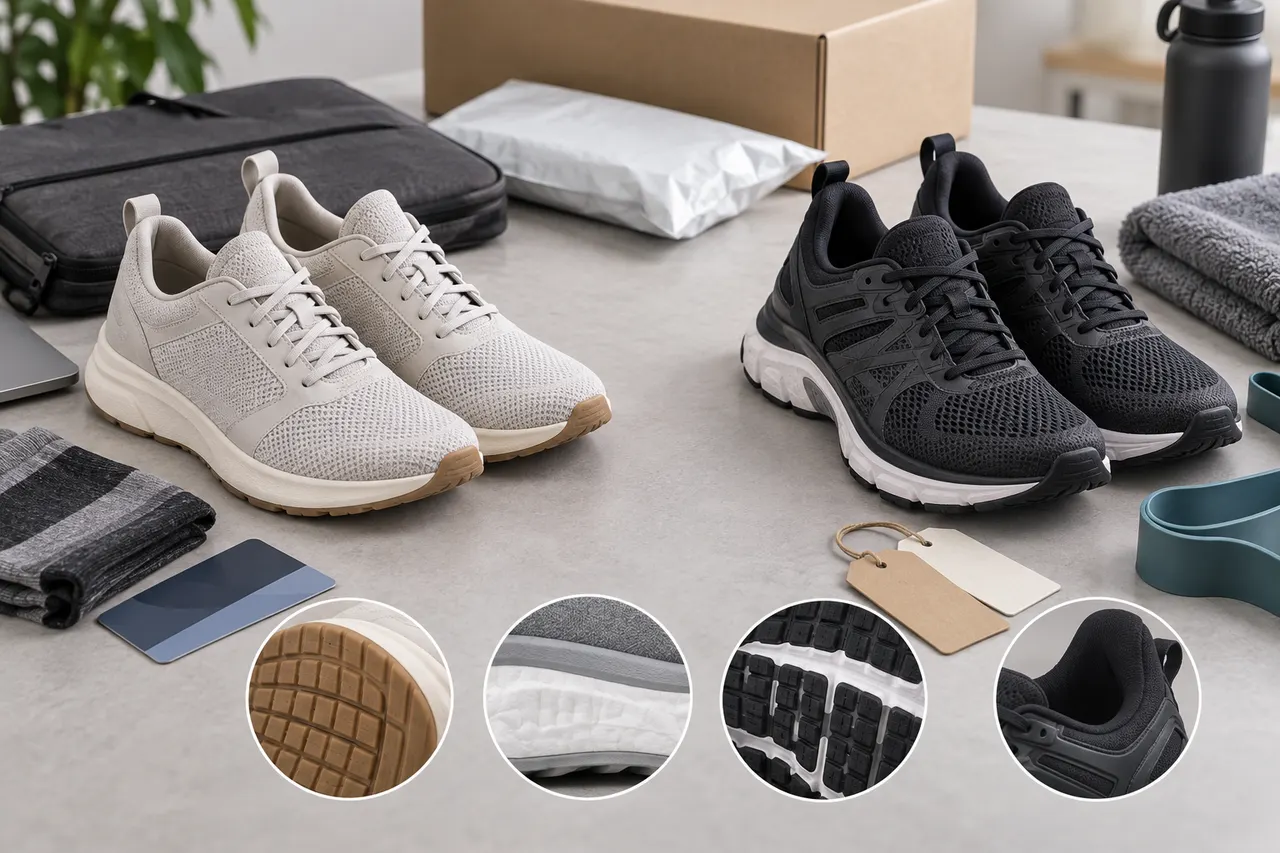
When picking sneakers on loongbuy, the real challenge is usually not "which pair looks better," but which primary scenario this pair is going to serve: daily commute walking or gym training support. Both needs involve words like "comfortable," "durable," and "supportive," but the judging criteria are not the same. The task of this article is to break down candidate shoes into observable checkpoints, helping you keep the pair that better matches your main purpose before placing an order, instead of being swayed by looks, discounts, and vague selling points.
This article is for buyers who have already seen several sneaker candidates on loongbuy and are ready to filter them through product pages and subsequent QC photos. It is not suitable for judging brand authenticity, medical foot issues, professional running shoe performance, or as a substitute for checking the latest policies of sellers, platforms, and shipping routes. Prices, stock, sizes, shipping fees, return/exchange windows, and destination country customs requirements may change. Before ordering, you should rely on the real-time information on the product page, platform order page, and carrier route page, and record the verification date as 2026-09-09.
First define the most frequent scenario for these shoes
Don't start by picking a colorway. The "goodness" of sneakers must be tied to the usage scenario; otherwise, you might easily end up with a pair that looks great in photos but you never want to wear daily.
If it's mainly for commuting, the core questions are usually: Can the shoes withstand repeated walking, standing, going up and down stairs, wet ground, crowded subways, and frequent putting on and taking off? Commuting shoes don't necessarily need extremely stiff lateral support, but they need stability, durability, easy pairing, and the upper should not be overly stuffy or hard to clean. 🚶
If it's mainly for fitness, the judging focus shifts to: During squats, deadlifts, machine training, short-distance movements, jumps, or group classes, will the foot slide inside the shoe? Is the heel stable? Does the outsole grip? Is the sole too soft? Training shoes are not necessarily suitable for long commutes because an overly hard or flat structure can make all-day walking tiring.
It's recommended to first write down a sentence:
The most frequent scenario for these shoes in a week is: commute walking, long standing in the office, gym strength training, cardio group classes, short runs, or daily styling.
Choose only one main scenario. Secondary scenarios can be considered, but they should not override the main need.
Break down commute durability and gym support into observable conditions
Commute durability is not judged by just saying "sturdy." You need to look at the upper, toe cap, outsole, heel, lace or Velcro structure, and whether the color resists dirt. Gym support is not just about thicker soles; it's about lateral wrap, heel lock, torsional rigidity, and landing stability.
Checkpoint | What to look for in commute durability | What to look for in gym support |
|---|---|---|
Upper | Is the mesh prone to snagging? Are leather or synthetic materials easy to clean? | Can the sides of the upper secure the instep? Is the flex point too soft? |
Toe cap | Is the toe room sufficient for long walks? Does the forefoot press on the toes? | Does the forefoot flex naturally? Will toes jam during training movements? |
Heel | Is the heel counter not easily collapsed? Is repeated on/off convenient? | Does the heel lock the foot? It should not feel obviously loose. |
Outsole | Does the tread cover major wear areas? Is the color resistant to dirt? | Does the tread have grip logic? Is it stable during lateral movements? |
Midsole | All-day walking needs cushioning but not a feeling of sinking. | Strength training usually doesn't suit overly soft, tall, or wobbly soles. |
Closure | Are laces, zippers, or Velcro convenient for daily on/off? | Can lace eyelets and wrap range be tightened on the instep? |
If a pair of shoes only advertises "trendy," "comfortable," and "versatile" without clearly showing sole details, upper details, and size info, it can remain as a style candidate, but it should not be ordered as a main commute or training shoe.
Extract upper, sole, and closure structure from loongbuy product info
On the loongbuy product page or agent purchase info page, first extract the visible information. Don't imagine materials from photos or treat seller promotional words as verified facts. You can record these fields:
Product title: Does it indicate sneaker, training shoe, running shoe, skate shoe, or casual shoe type.
Upper info: Does the page clearly state mesh, leather, synthetic leather, fabric, suede, or other material.
Sole info: Does it state rubber sole, foam sole, thick sole, air cushion, board sole, or other structure.
Closure: Lace-up, slip-on, Velcro, zipper, or combination.
Size range: Is there a clear size chart? Does it distinguish EU, US, or centimeter foot length.
Product images: Do they include side, toe, heel, outsole, inside label, or size tag.
Seller restrictions: Any notes on color, size, stock, or shipping.
The value of loongbuy is that buyers can continue to verify information around Chinese product links, orders, and warehouse steps, but that doesn't mean details not written on the product page can automatically be assumed. For example, if the page doesn't clearly show the outsole tread, you can't directly say it has "strong grip"; without a size chart, you can't say "true to size." 🧾
A practical approach is to divide candidate shoes into three categories:
Category 1: Complete info, can proceed to order and QC verification.
Category 2: Nice photos but insufficient key info, need to confirm with seller or customer service first.
Category 3: Conflicting title, images, size, or materials, should be temporarily eliminated.
Use QC photos to check toe, heel, outsole, and left-right consistency separately
Warehouse QC photos are not for re-appreciating the colorway, but for checking whether the product matches your order goal. After receiving QC, it's recommended to look in a fixed order, not just the first overview photo.
First look at the toe. The height, curve, stitching, and symmetry of the toe caps on both shoes should be roughly consistent. For commuting shoes, pay special attention to whether the toe has dents, obvious creases, or glue overflow; for training shoes, also check if the forefoot area is too narrow, because toes need to spread steadily during training movements.
Next look at the heel. If the heel counter is obviously crooked, collapsed, or has a large height difference between left and right, it may cause chafing during commuting and affect heel lock during training. Heel pull tabs, collar padding, and collar edges should also be seen clearly, especially where thick or low-cut socks may rub.
Then look at the outsole. The outsole photo is crucial, but many buyers skip it. For commuting shoes, check whether the wear areas have complete tread, whether the sole has obvious dirt or deformation; for training shoes, check whether the outsole is flat, has enough ground contact area, and whether the left and right tread patterns match. 🏋️
Finally look at left-right consistency. Zoom in on the side-by-side photo of both shoes and check whether the tongue length, lace eyelet positions, side logos, heel height, outsole edges, and color shade differ noticeably. Minor craftsmanship differences may not affect wear, but obvious asymmetry, wrong size, wrong color, dirt, separation, or damage should be addressed promptly.
Build a decision comparison table for commuting shoes vs. training shoes
A true either-or choice should rely on scoring the main scenario, not feelings. The table below can be used directly for candidate A and candidate B. Score each item as 0, 1, or 2: 0 means insufficient, 1 means acceptable, 2 means clearly matched. Keep only the candidate that better fits the main scenario.
Item | Commute candidate focus | Gym candidate focus | Recording method |
|---|---|---|---|
Size certainty | Has size chart, foot length corresponding clear | Interior space controllable, not loose or tight | Record page size and your foot length |
Upper durability | Easy to clean, not prone to snagging or wrinkling | Wraps instep, won't obviously splay out | Judge from product photos and QC photos |
Heel stability | Not chafing during long walks, reasonable on/off | Strong heel lock, no shake during movements | Look at heel counter and collar structure |
Outsole performance | Durable tread, suitable for daily ground | Stable ground contact, no instability in lateral moves | Must check outsole QC photos |
Midsole tendency | Moderate cushioning, not tiring all day | Should not be too soft or tall, reduce wobble | Judge cautiously from description |
Risk cost | Cost of dealing with dirt, separation, size mismatch | Insufficient support may affect training experience | Judge with return window and shipping fees |
If your main scenario is commuting, and the commute candidate's total score is higher than the training candidate's, don't change your choice just because the training shoe looks more "professional." If your main scenario is gym, and the training candidate is clearly better in heel stability, outsole ground contact, and upper wrap, even if the commute candidate is more versatile, you should prioritize keeping the training candidate.
When not to rush an order due to insufficient info
The following situations are not recommended for rushing payment or submitting international shipping:
No clear size chart on the product page, and inconsistent sizing systems in different images or titles.
No outsole pictures, so you can't judge tread, ground contact area, or left-right consistency.
Upper material described only with promotional words, no visible detail support.
Notable discrepancies between seller photos and QC photos in color, structure, lace eyelets, or heel shape.
Shoe boxes, labels, or accessories are not your core need but significantly increase volume, weight, or shipping risk.
Destination country has extra requirements for footwear, brand logos, declaration documents, or import restrictions that you haven't verified.
Return/exchange window, warehouse handling fees, domestic return shipping fees, or international route restrictions not confirmed.
Especially avoid a common misjudgment: to "save on shipping," directly combine uncertain shoes with other items. Combining may reduce repeated first weight or handling costs, but it may also increase volumetric weight, parcel value, and single loss risk. If shoe size, condition, or route restrictions are not confirmed, it's safer to resolve issues before combining. 📦
Final choice: keep the sneaker candidate better matching the main scenario
The final choice can be simple: if one pair's strengths are mainly durability, easy cleaning, reasonable toe room, complete outsole tread, and dirt-resistant color, it is more suitable as a commute candidate. If another pair's strengths are heel lock, upper wrap, stable outsole ground contact, and a midsole that is not mushy, it is more suitable as a gym candidate.
Don't try to make one pair with insufficient info do all tasks. Commuting and gym can overlap, but when ordering, you must serve the most frequent scenario first. For most buyers, the better decision is not to buy the shoe that "sounds strongest in reviews," but the shoe that "has enough visible info, can be QC-verified, and has acceptable risk cost."
The savings from this article come from reducing wrong sizes, wrong scenarios, and unnecessary returns: filtering out candidates with insufficient info in advance may save domestic return shipping fees, warehouse processing time, and waiting costs before international shipping. The added risk is that you might miss a stock or discount because you insist on verification. People suited to this method are buyers who already have 2–4 candidates and are willing to look at product page and QC photo details. Situations not recommended: if you need professional sports performance, foot medical advice, brand authenticity conclusions, or must rely on real-time stock and prices for instant purchases.
Keep the pair that better matches the main scenario, then proceed to payment, QC, whether to return/exchange, whether to combine, and international shipping decisions. This choice will be a bit slower, but the error cost is usually lower. ✅
agent platform shopping FAQ
1. What is the purpose of using a spreadsheet on loong-buy.com?
Since agent platforms rarely show products directly, you need a spreadsheet to locate the items you want and obtain their purchase links on loong-buy.com. Another option is to ask for advice on Reddit or Discord; the suggestions there are often great, but the buying procedure tends to be slow. These spreadsheets are usually built over a long time by collecting data from those platforms.
2. What categories of products can be found on loong-buy.com?
loong-buy.com provides a wide assortment of product types, such as shoes, T-shirts, sweaters, hoodies, jeans, sweatpants, shorts, beach shorts, factory clearance goods, down jackets, baseball jerseys, shirts, hats, jewelry, bags, electronics, sunglasses, socks, underwear, and popular collectibles.
Browse our latest products and find your next favorite item.